Before ayahuasca became a laboratory subject, retreat offering, or podcast topic, it was already a relationship among plants, forest, body, community, ancestors, prayer, and song. This article approaches its mystery without abandoning history, evidence, or safety.
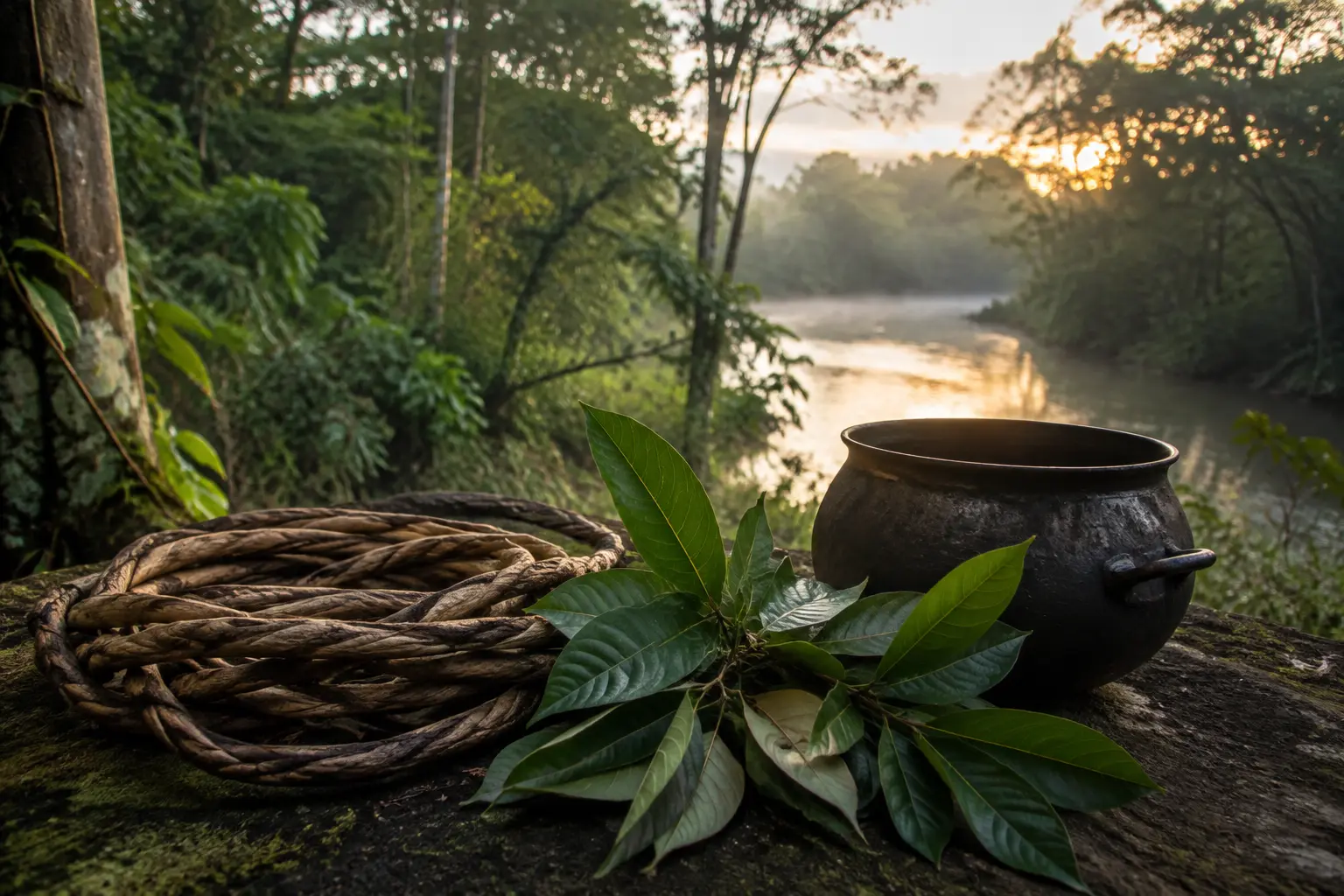
Before the molecule, there was a relationship
Reducing ayahuasca to “liquid DMT” erases a long history; describing it as a guaranteed cure ignores real risks. Across different Amazonian peoples, the brew belongs to distinct systems of knowledge, healing, learning, and world-making. Bodies, emotions, ancestors, dreams, community, plants, and song may all participate in what the English word healing only partially captures.
Brazilian neuroscientist Sidarta Ribeiro proposes understanding psychedelic research in three broad waves. The first did not begin at a university: it consists of Indigenous discoveries, practices, and cultures developed over generations. Twentieth-century science and the current research revival came later. This order matters. Science can measure outcomes and test hypotheses, but it should not announce as a novelty what forest peoples preserved through violence, stigma, and appropriation.
Where does ayahuasca come from?
Ayahuasca is a Quechua word often translated as “vine of the spirits” or “vine of the dead.” It is only one name among many: daime, vegetal, yajé, kamarãpi, nixi pae, uni, and huni are used in different languages and settings. There is no single “ayahuasca culture.” Huni Kuin, Yawanawá, Ashaninka, Sharanahua, Shipibo-Konibo, Tukano, and many other peoples maintain their own narratives and protocols. Caboclo, vegetalista, and Brazilian religious traditions have also developed particular forms of consecration.
A common preparation combines the Banisteriopsis caapi vine with DMT-containing leaves such as chacrona (Psychotria viridis). Beta-carbolines in the vine reversibly inhibit the MAO-A enzyme, allowing orally ingested DMT to become active. This pharmacological explanation is important but incomplete: it describes molecular action, not the whole meaning of a ceremony. Ingredients, concentrations, names, and forms of preparation vary. This article is not a preparation or consumption manual.
A Yawanawá account of the origin of Uni
Among the Yawanawá, one account recorded by researchers connects the origin of Uni with Puyahunihu, a great leader and spiritual knower. In versions of the story, his death—situated in a time when people did not yet know death as they do now—turns grief into knowledge. Powerful plants emerge from his body or burial place, including different vines, tobacco, and pepper. By drinking Uni and observing a period of discipline, his relatives learn to become light and to reach or reunite with the domain of spirits.
The narrative has variations and shares relationships with other Pano stories involving the anaconda, designs, songs, and the transmission of knowledge. It is neither an encoded botanical report nor decorative “folklore.” The story thinks through foundational questions: why humans die, how the dead remain present, where knowledge comes from, and what discipline makes a person able to receive it. Speaking of “the Indigenous myth of ayahuasca” in the singular would erase plurality. This is one specifically Yawanawá tradition, whose deepest meanings belong first to the people who carry it.
What is it for—and what does healing mean?
The biomedical question—“which symptom decreased?”—is legitimate, but smaller than the Indigenous field of healing. In contemporary clinical language, the clearest promising results concern depression. A Brazilian randomized placebo-controlled trial involving 29 people with treatment-resistant depression found a stronger reduction in symptoms on day seven after a single session. This is a meaningful signal, not permission to promise a cure: the sample was small, and convincing blinding was difficult.
A neuroimaging study from Sidarta Ribeiro's research group observed changes in activity and connectivity within hubs of the default mode network in ten experienced users. Without a placebo and with so few participants, it helps generate hypotheses; it cannot establish by itself why someone improves. Ribeiro also discusses the possibility that psychedelics support metaplasticity—a period in which rigid patterns may become more available for revision. A window is not a destination. What happens before, during, and after remains decisive.
Therapeutic potential is therefore not the same as universal treatment. An intense experience may reorganize meaning; it may also destabilize someone when screening, setting, preparation, and follow-up are inadequate. The most credible position is neither automatic dismissal nor miracle marketing. It is careful hope, proportionate to the evidence and the person in front of us.

Prayer and song are not background music
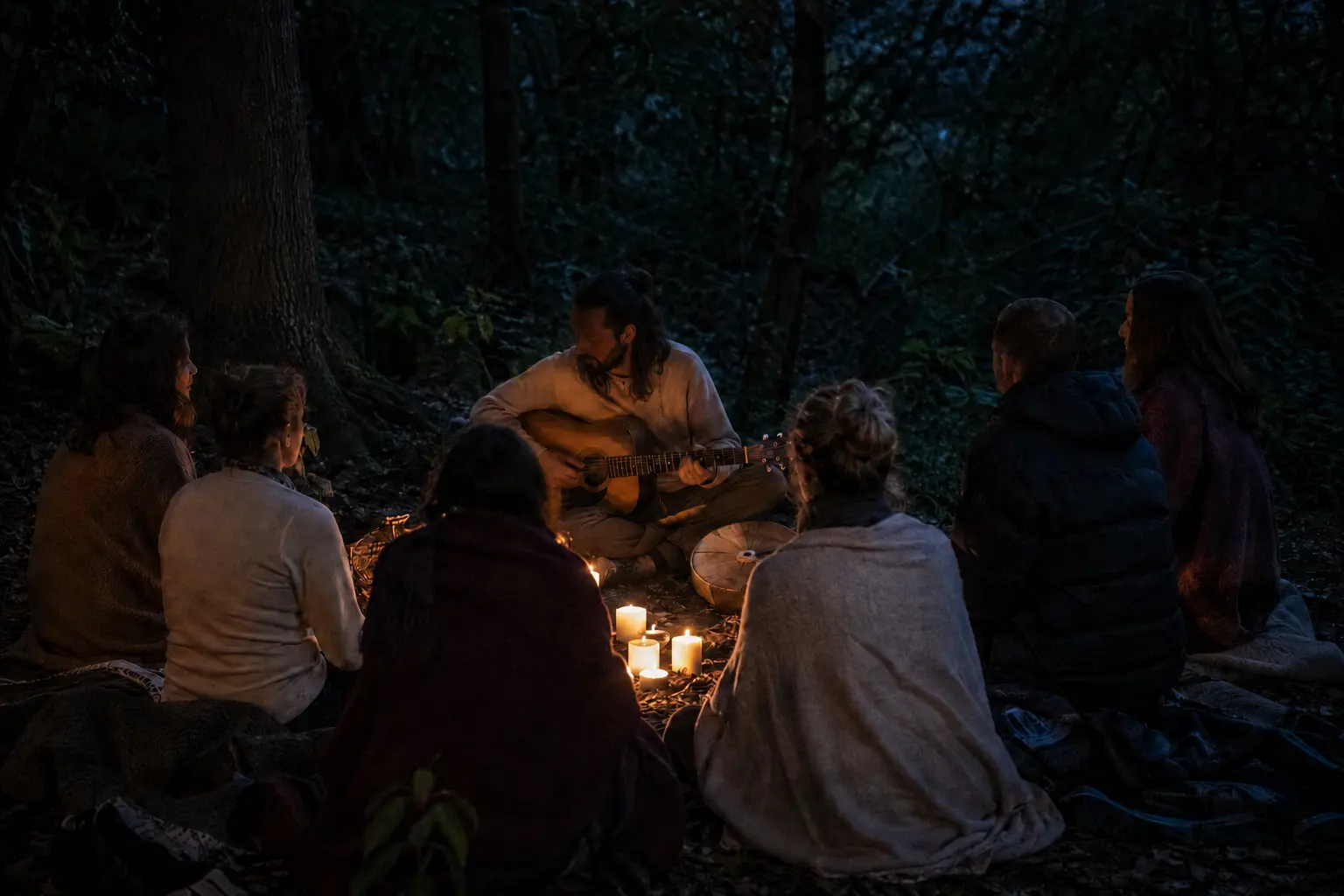
In many traditions, song directs the work: it may call, cleanse, protect, organize experience, and transmit knowledge. Each people has its own names, repertoires, and ways of learning. Icaro is a term associated especially with Peruvian mestizo vegetalismo, not a universal label for Indigenous music. For a responsible facilitator, prayer requires memory, presence, accountability, and sensitivity to the group. It is not an exotic accessory or a performance for visitors.
Contemporary research also recognizes that music, expectation, relationship, and environment influence psychedelic experiences. Song may lend rhythm to breathing, provide a point of attention through fear, and strengthen collective orientation. This psychological description does not translate an entire cosmology into clinical terms; it simply identifies one place where different languages meet. As Ribeiro emphasizes, the belief that a substance produces mental health independently of context is mistaken. Safety includes who facilitates, how distress is handled, and what support exists afterward.
Terence McKenna: imagination, forest, and a necessary boundary
Terence McKenna introduced psychoactive plants and expanded states of consciousness to a broad international audience. In True Hallucinations, he narrated his 1971 Amazonian journey with his brother Dennis and turned direct experience, language, nature, and an “archaic revival” into powerful cultural questions. His writing restored mystery to a world he considered excessively domesticated.
McKenna should not, however, replace clinical researchers or Indigenous authorities. Many of his hypotheses are speculative, and Western popularization has often blended distinct traditions. He is most fertile as a philosophical provocateur and narrator of experience—not as an authority on efficacy, safety, or Indigenous history. Ribeiro's science and McKenna's thought can meet when each remains identifiable: one measures and revises; the other expands the imagination.
Contraindications: who needs to avoid it or receive specialist assessment?
Ayahuasca is not safe for everyone. Nausea and vomiting are common; automatically calling them “detoxification” can conceal dehydration, aspiration, or unnecessary suffering. In a large international survey, about 70 percent reported acute physical adverse effects and 2.3 percent required subsequent medical attention. Psychological difficulties in the following weeks or months were also reported, even though most respondents ultimately described the process as positive or growth-promoting. A group average never replaces individual screening.
A personal or family history of psychosis, schizophrenia, mania, or bipolar disorder demands particular caution and usually exclusion. Serotonergic medication, MAO inhibitors, stimulants, and other substances can interact with the brew. No one should stop prescribed medication independently; only the prescribing professional can evaluate a safe plan. Uncontrolled hypertension, significant cardiovascular disease, seizure history, pregnancy, breastfeeding, acute suicidal crisis, or severe psychological disorganization also require avoidance or specialist assessment—not spiritual exceptions.
Safety also depends on the provenance of the preparation, consent, the ratio of participants to caregivers, abuse prevention, emergency access, and a plan for complications. In Brazil, CONAD Resolution 1/2010 establishes principles for religious use. It is not medical approval and does not authorize indiscriminate commerce or therapeutic promises.
- Ask about medical and psychiatric screening before any ceremony.
- Never hide medication or substance use from the responsible team.
- Do not confuse a charismatic leader, beautiful setting, or intense experience with adequate safety.
- A responsible organizer can explain limits, consent procedures, crisis response, and post-ceremony support.
Integration does not exclude psychotherapy
A vision, memory, or sense of unity may be profound without arriving with instructions. Integration means revisiting the experience through time, language, the body, relationships, and concrete choices. Psychotherapy can help distinguish symbol from fact, hold trauma safely, recognize projection, and turn insight into sustainable change. The more responsible clinical protocols do not offer an isolated substance; they include preparation, support, and integration.
Ayahuasca does not replace a psychologist, psychiatrist, medication, medical care, or emergency support. Psychological follow-up does not need to invalidate spiritual meaning either. When both sides respect their boundaries, they can protect the person's autonomy. Mystery matures when it is not used to abandon reality, limits, and responsibility.
Sources and further reading
- Sidarta Ribeiro — Psychedelics, context, psychotherapy, and Indigenous knowledge
- Palhano-Fontes et al. — Ayahuasca and the default mode network
- Palhano-Fontes et al. — Placebo-controlled trial in treatment-resistant depression
- Matos — Pano myths of the origin of ayahuasca
- University of São Paulo — Puyahunihu and the origin of Uni among the Yawanawá
- Global Ayahuasca Survey — Physical and psychological adverse effects
- Systematic review — Ayahuasca, DMT, and psychotic episodes
- Participant experiences of healing songs and icaros
- Terence McKenna — True Hallucinations
- Brazilian National Council on Drug Policy — CONAD Resolution 1/2010